


Euroscan
1st Generation
Euroscan
1st Generation
19/12/2016
Few days before Christmas holidays!
It's been six months since I got that desired model and until nowadays, I have finished 2 of 4. Now I am working on the third one.
It's been an exciting journey! The first 2 repairs were successsful and the lights are working properly.
Two of them will have and MSD / HSD 250 Watt lamp,
while the other two will be an ECO version with a Master Colour CDM 150 Watt lamp, 9000 hours of life.
The brightness is very satisfying in the ECO version too!
In the following sections I will write details about their restoration.
Almost 10 years after the restoration experience, I decided to give to my favourite old model a proper detail. Below, follows an updated version of this page, with more details and visual materials regarding this project, and how this model, in combination with a newly built club back on '91 in my homeland, triggered my obsession with the scanners.
I hope you will enjoy reading my story! Elias 28/08/2025

The big impression of 1991
The good, life-changing trauma, as I describe it, happened back in 1991 in Antiparos, when the first 'club' opened on the island, the Mariano Club. Until then, there were only 3 discos present for locals and tourists' entertainment, all of them with unique styles, connected with the beautiful Cycladic simplicity and architecture.
In 1991, I was 8 years old, and I was already spending every summer in Antiparos, together with my grandparents, cousins, and family in general. I was lucky enough to experience the discos, since my mother and her sisters were very young, and the things on the island in terms of tourism were much calmer in comparison with what is happening nowadays. The island is small, everybody knew everyone, so no matter my young age, there were times my mom and her sisters and friends let me come with them to the Ntiskotek, as we called it. There were many places to trigger my love for lighting, as Antiparos had many awesome, styled and decorated bars and pubs, with pin spots, indirect lighting, disco balls, and black lights. And some of you might remember the decorative glasses with colored sides, small lights inside and the straw! These were just toys for me, though. I was going for the real stuff! On the contrary, advanced disco effects, like helicopters, swipers, for example, were not available there. The first moving fixtures I saw back then were in the Disco Tropical, which had four pin spots scanning fast left and right across the dancefloor.
So, in the summer of 1991, relatives were talking about the newly built Mariano Club, and my first question was what kind of effects it has, of course. I remember my cousin (this is why I call it trauma with a good way, as it makes me remember details from such a young age, details that in any other case I believe I would have forgotten) saying that it had "two like black boxes with a mirror, which produced different colours and stars, heart shapes". I just needed so badly to see what he meant by such a description.

Mariano Club outdoor section (up), as it was on 2016, and the entrance section as it looked like on 2004 (down).


Euroscans: The first contact
And I didn't have to wait too long for this moment to come. I will never forget this! Firstly, I was amazed by the place itself. There were so many trees, among them palm trees, which made the place look like it had stood there for even the previous decades. Even though from my young age, I was able to explore the island alone, or with my cousins, on foot, or with our bikes, in 1991, too young, of course, and I was still under the heavy protection of my grandparents, so I haven't seen the process of building up, as I have never been on this area. There must be something else there, due to all the trees surrounding the area, but it should probably be a house, and not another entertainment establishment.
From the entrance, you would find yourself in the outdoor section, where the lighting was discreet, warm, and dimmed. Turtle fixtures were located within stone walls and benches, both inward and outward, throughout the surrounding garden. Recessed spots also started becoming a trend at that time. And then it was the indoor section of Mariano Club, where everything regarding the scanner lights began. I was left in awe by the architecture, firstly, as there were curves, corners, and different levels on the floor and the ceiling as well. The atmospheric, simple lighting with the recessed spots on the two-level ceiling, and islandic architecture with the stone and white walls, gave such a cool vibe and sensation, together with the music as well, since in Mariano, you wouldn't listen to just mainstream music, but genres ranged from dub, trip-hop and acid jazz, to deep house and techno.
The spots had blue filters installed, a bit lighter than the indigo shade, and they were connected to a chaser, producing soft waves, phased fade-ins and outs. The spots remained simple in their operation generally, while the main effect features for the dancefloor were the two Euroscan with the killing luminosity of the HTI 400 lamp. There is a two-level ceiling, where the highest part, together with the walls around it, was black, and the low ambient lighting gave a roofless impression as you entered the place.
I remembered clearly the moment I saw the scanners, a large and totally imposing lighting fixture. Since we were early, no one was dancing yet, so I was moving around shyly and discreetly, trying to observe all the details of these rugged style machines. I could clearly see the front dark panels, the soft neon power on indicator on their cover on the top, their cut-off corners, as well as the large mirror with the silver yoke behind it.
These fixtures were not DMX, and they had a console with preprogrammed modes and a simple manual control. Electron Company, their manufacturer, offered either simple consoles or programmable ones, with the ability to address the fixtures. The Euroscans in the Mariano club worked in the same way simultaneously; they just scanned the area in the opposite way since one was against the other.
They were just paused on the open gobo, with the magenta colour. I remember it like it was yesterday, how bright and vivid the colours were, as back then the only thing I had seen live were the pinspots, which also had awesome colours, as gels were used back then. Nothing to compare with the brilliance a magenta colour had, with a metal halide lamp of such power as the light source.
It was getting late on that day, and more people came and started dancing, and the scanners started moving as well. The fixtures were, of course, pretty simple with their colour and pattern projections, but even with their micromotors, they made quite the chaos on the dancefloor. The sound to light magic button the console has, did the show for the whole night, and the scanner's response with the bass of the diamonds the DJ played these nights, was, and it is still for me, the coolest. If you ask me, when it's about listening to dub, or drum'n'bass, or generally the 90s, I would prefer to turn on my Euroscans and press the 'music' button, as it was labelled. The colours and gobos would change every couple of seconds, with random intervals, while the console would give you the ability to deactivate the auto change, select them separately, or change them manually to the frequency of your choice.
And that was it. An 8-year-old kid was totally obsessed with these lights and the place which accompanied them. The first generation, as I call them, Euroscans, are connected with Mariano Club, with my summer holidays in Antiparos, and so many songs from the 90s.

A desperate, late search
and the 3 surprises in a row!


1. 'I spy with my little eye... a scanner!' An Euroscan spotted in the Galea Club.
2. The larger & wider version with the MSR 1200 lamp. This PA company also had the HTI 400 versions.

3. The picture sent by the owner of the club in Euboea confirmed that those were the models I was looking for.

Years passed, but I never had the nerve or the self-confidence to be in closer contact with the owner, as I didn't have any idea how these things worked. The experience for repairs or control came much later, when it was too late for either repairing these fixtures for re-use by their owner, or even getting them as a start to my personal collection of old fixtures. When I called the owner to ask if these scanners were somewhere in his properties, it was too late, as he replied, 'I do not have them anymore. '
The thing is that Euroscans lasted long enough, for 13 years, working only on the summer/spring seasons, from 1991 to 2004. For many years, I didn't have the idea of collecting old fixtures, even though I had in mind these Euroscans, the Cyberlights, the Golden Scans, the Miniscans and so on. Instead, I wanted to purchase new lights and moving heads, as I was generally interested in stage lighting, and I wanted to see them for myself and learn from them. I should start searching for used fixtures, but I was destroying my yearly savings for new ones instead.
The spark of getting old fixtures started in 2011, as time-to-time memories from the Mariano and the Euroscans resurfaced, and I realised that the years go by, and I may not be able to find the same model. As a substitute for those from the Mariano Club, I couldn't recover.
Fun story: In Antiparos, there were places where people threw away things, like old cars, bikes, washing machines and so on (of course, we are in the Balkans, where no absolute respect for the environment, nor control and punishment for such pollution exists). Years ago, I was exploring with my bike desperately, like a scrap collector, literally searching among rusty stuff in case they had thrown them in such areas. No luck. I still believe that no matter their state, if I had found them in such places, no matter their status, I would have taken them. An interesting parenthesis in this story I would like to note is how the sea cleans everything. One of the areas which had metal garbage was in a rocky area, some tens of meters from the sea. Year after year, the wind and the seawater destroyed the metals to dust, and nowadays there is nothing left to remind us that the area was used for scrap disposal. Nature and time at their best, healing the island.
It was one of the moments I was upset with my lack of confidence and the willingness to just go and talk to people. But it's funny that sometimes in life, either you will have to be patient for a very long time in order to do/gain something, or life will throw you multiple circumstances and chances to make a dream come true.
In a later period, I started the online treasure hunting, scouting the Facebook groups of various famous clubs in Paros, some of them quite 'historic' and active for 20 - 30 years. One of them was the Galea Club. My eyes caught the long-desired Euroscan on one of the pictures. So through Facebook, I contacted people who worked there, and then the owner, who was very approachable and kind, and he still had the fixtures in his warehouse. It would be a more complicated process to get these lights, as they were on an island, but I was so happy I have something great to look forward to for my summer holidays.
In the meantime, I've contacted an old PA company in southern Athens, which I knew was active during the golden decade. I had the opportunity to visit the company and see some old fixtures, in a very bad state, but again, to my surprise, there it is the same model with the micro motors. The person who worked on that evening managed to slide down the front cover and see the gobo wheel, which, of course, had the same gobos I remembered (instant goosebumps and thrill, which I hid unusually well, I think I was shy enough not to act like a kid in front of people I had just met). Unfortunately, I couldn't get fixtures from this company, as the owner wanted to restore them and throw a huge 80s party, as he said. I was not happy, since I know these people would never invest time, money and effort in such old fixtures. I bet they are still rotting in his warehouse, if not thrown into the recycle.
On the same period, I was already working on my first job related to entertainment sound and light in Athens in a retail store, and I happened to meet another, very kind and talkative person, who had for many years an outdoor club on the Euboea island [Euboea is the second largest island in Greece, and very close to Athens, on which you can go by car as well]. The discussion led to the old fixtures, and he mentioned that he had scanners from Electron, but he wasn't aware of the model. We connected on Facebook, and he was way too kind, as soon as he got back home, to send me a picture of the fixtures, and to my great surprise, they were the first-generation Euroscans! I was in complete shock, as it was the third finding of the same model in just a few weeks! You can imagine, if you are a collector reading this, how I felt!
Since Euboea is closer to Athens, and I would never delay such an opportunity, I travelled on the Saturday of the same week to get them.
And here we are!

It was a beautiful summer day when I travelled to Euboea to get these 4 scanners. I had an interesting, long discussion with the owner, and then we went into his warehouse to load them into my car. The scanners were in a much worse condition than the ones the picture gave me an impression of. Of course, there was no thought of abandoning them; I was thinking then, "I will do my best to make you shine and work again".
They were the fixtures with the worst condition I ever managed to restore, with the second project, the two ClayPaky Stage Lights, which were abandoned in a field. At least those Euroscans were outdoors, but covered somehow. If they were fully exposed to weather conditions, they might be partly disintegrated by rust.
These Euroscans were the budget version, as they had a 36V, 340 Watt halogen reflector lamp as a light source. It was so strange to see a fixture of that size, with an MR12 lamp inside. However, the internal design was common for both lamp versions, with the two Sunon fans and the air direction vent/system. HTI 400 requires the air to flow on the front of the lamp as well, to cool the front and back ceramic rings.

HTI 400 was also used in the second generation with the same housing, but stepper motors, and colour/gobo wheels with multiple patterns, and a smaller lightpath with a diameter of 10 mms. The first generation has a larger aperture and front lens; however, I am not aware if they used extra optics with the metal halide lamp. However, the light field was uniform, and no hot spot was observed. The lamp was suitable for effects and a light path of approximately 30 mm in diameter.
The good thing with such a large fixture was that I had many choices for the light source, as there is enough space to accommodate CMD, MSR or MSD lamps. The 36V transformer for the small halogen MR12 lamp had the size of a balast.
Taking them home
A new restoration experience started!


The longest restoration
always deserves the effort.

1 out of 4 had a fixed-cut gobo disk. I wondered how much older this one could be.
Sections of Instagram stories of that time, with cleaning up the rust from the steel parts.
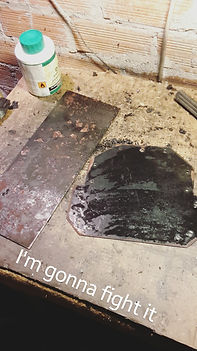
I had two challenges to face: damaged housing parts, which required loads of work, and electronics design, on which I had no experience.
I decided I should complete them one after the other, and not all together. In that way, everything will be kept 'originally' as they were, and I wouldn't get psychologically overloaded from working on so many random parts. This way proved the most satisfying for me, as when I completed the first successfully, I had more boost and positive energy to continue with the others.
Definitely, most of the time was consumed by the metal housing parts, as I needed to strip the paint and rust from every single piece. I remember this was the period I got most of the tools for jobs like this, and I needed so many sandpapers! It was the first time of putting so much of such work, and now that I am thinking of this, I would have done things differently in terms of the painting.
I spent about 2 months on each fixture, doing all the work on the weekends or weekdays after my regular job.


Electronics
discovering the micromotors control logic

1. Operational amplifiers on the main board send the voltage levels for the scanner's functions.
2. Micromotors control PCBs for Pan/Tilt and Gobo/Colour wheels.

The main PCB is quite simple as well, but most of the chip labels were scraped off, possibly to avoid other technicians from servicing the devices, so only Electron, as the manufacturer, or official resellers can service them. For once more, I was lucky enough, as one of the four scanners, to have the ICs intact.
I remember when I finished the first Euroscan. I had it on the balcony, so the heated paint would release the smell, and I wouldn't suffocate in my attic. I was so eager to see it operating and projecting the gobos and colours, that it was the first time I completed a fixture in 100% before first checking if the electronics were operating correctly, if the wheels were calibrated, and so on. I was like an adrenaline junky in that moment. So I turned on the light, the lamp turned on, I waited a bit to warm up, and connected the console, but there was no response. No reset, no response when commands were sent from the console. From the excitement and impatience, I couldn't think clearly; I was like intoxicated. As soon as the disappointment hit after the 'let me die, I don't want to work anymore' message from the old scanner, my impetience and excitement levels decreased, and common sense was back on.
Just before I turned the power off, I remembered that the control PCBs had the trimmers, marked with min and max labels. And since I installed new trimmers, by default, they were in the zero position. So, I soon as I started adjusting the trimmers, and since from the console there were also commands given, the wheels and mirror started positioning. IT WAS ALIVE! An epic moment and memory to cherish.
With that specific scanner, I was lucky enough as the position potentiometers were in a proper setting, so adjusting only the min and max trimmers for each function was enough to put the scanner to work properly. There were cases where the wheel, in relation to the position potentiometer, must be adjusted as well, so, for example, the open position for the wheels to be within the range of the MIN/MAX trimmers. The same applied to the mirror, as it could rotate 180 degrees if not properly adjusted. For example, for the mirror, I would set the MIN trimmer almost to zero value, I would release the Bourns potentiometer axis from the gear (which connected it to the mirror), and I would turn it with a screwdriver slowly. The mirror would move to the desired zero position. The maximum position would be adjusted by setting the maximum pan from the console, and depending on the final mirror position, the MAX trimmer should be adjusted accordingly.
So, after not even an hour of having this fixture first plugged in, I was able to get it up in the attic, and see after ages the sound to light program and the gobo/colour change on the most desired model at that time, remembering the good old summers at the Mariano Club. And not only that, I was able to listen to the sweet sound of the DC geared motors while working fast. Like a big toy for a big boy!
So the first scanner was used as a 'service seminar' and I knew what to expect and adjust in the rest. I realised how simple this logic was, as while measuring the outputs, I saw that each step for the colours and gobos was represented as a different voltage level on the LM324N operational amplifiers. First colour was 3V, second 6V and so on. I was thinking that with proper control, these fixtures could also do gobo and colour scrolls. Such an option was not offered, though.
I was doing the hard job restoring the housing mostly on the weekends, in my basement, while the most delicate job on cleaning the electronics and wheels, in my attic, the weekdays. I can say that I was proceeding in parallel with both 'sections' of this restoration.
I was trying to figure out the operation logic of this design, which included DC motors only and trimmers for the positioning. The main PCB had an impressive input of 4 different voltages, and each motor was controlled by a TDA2030V IC, which I was impressed to discover, while searching for details, that it was commonly used in sound amplification circuits.
Each pair of motors had its own control PCB. One for the gobo/colour pair, and another for the Pan/Tilt. There is also a shutter in this fixture, and the driver was on the main PCB with the microprocessor. It was the only motor with no position potentiometer.
For the rest effects, a potentiometer with unlimited rotation from Bourns was included in the circuit, used as a feedback for the motor's position. I was impressed to see how much accuracy and speed, especially for the mirror movement with the sound mode, this system offered.
The small control PCBs with the potentiometers had to be renovated almost completely. I was thinking that I should not do 'half-work' on this, knowing the age of the fixtures and the terrible condition they were saved from. Only the resistors weren't replaced. It was one of the most satisfying jobs, making a whole PCB completely clean and shiny new.

3. The main PCB, has only the shutter driver IC.
4. Testing the wheels position after calibration.


5. Details from the mirror head.
6. Pan and tilt testing after adjusting the trimmers.


Light Sources
Metal Halide Lamp and components adaption
.jpg)

Set up for the CDM-150 (left) and MSD-250 (right) lamps. I've made a holder for the capacitor and starter out of an aluminium sheet. Thankfully, the board had enough holes to accommodate everything without extra drilling.
Purchasing an HTI 400 was out of the question, not only due to the extreme costs but also because of the limited operating hours.
I have previously experimented with light sources. On the newer version of this scanner, specifically the one with the stepper motors. I also attempted to install a CSR (MSR) 575 lamp, but even with the two 240 Volt Sunon fans, the housing was too hot, so 400 Watts is the limit. MSR 400 has a different base, but the same size as MSD 250. From my 4 stepper motor-driven Euroscans, I made two MSR 400 and two MSD 250.
During the restoration, I ordered four good-quality dichroic reflectors, originally belonging to moving heads, so they were ready for installation on my custom-made holder. The reflector placement was a challenge, but doable. If the scanners accommodated the HTI 400, I bet it would be way simpler to install this mode. But only if the reflector had a slightly smaller diameter in comparison to the HTI's ceramic ring.
In that period, due to the lack of spare 250 Watt ballasts, I made two fixtures with MSD 250, and two with CDM 150, low-cost, but high-luminosity and long-life lamps. Ballasts and starters for the CDMs could be found easily and at a very low cost, as these light sources are commercially used. I was looking for long-life lamps, as replacing them in this fixture is a bit time-consuming because of the modifications I made, and the lamp adjustment process for the proper light focus against the reflector.


Epilogue
Thank you for reading my story!

If you reached this point, thank you so much!
I felt that the model, which ignited the passion I have for this field, didn't receive the proper attention and presentation on this website since 2016, when their restorations took place. Since I moved abroad, my mind is calmer, and my recent summer holidays in my homeland brought all the memories back to order, and the time felt perfect for writing them down.
I hope you enjoyed that trip!
Do not hesitate to contact me if you have any questions. I am always so excited to talk with other collectors; it will be a pleasure!
Elias, 02/09/2025
The sound-to-light of the console made the show. My favourite function!


I was able to install one of the Euroscans in the same way as they were in the Mariano Club, on the attic's tallest area, and enjoy its looks!
Not much, just 5 patterns and 5 colours. Still back in 1991 when I saw their projections and aerials, was the coolest thing ever!
Apart from the excitement and closure the finding of that model brought into my life, the result of this project made me really proud!
